Magnet Fishing Rope and Knots: What to Buy and How to Tie
The Two Things Standing Between You and a Lost Magnet
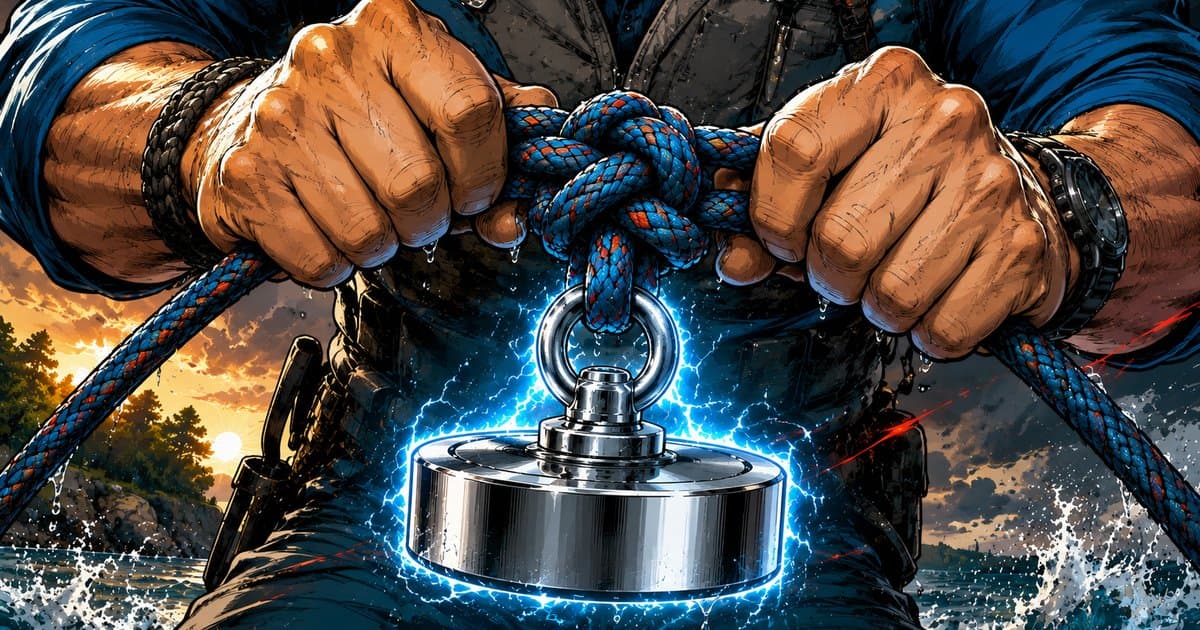
Almost every lost magnet story comes down to one of two failures: the wrong rope, or the wrong knot. People obsess over pull force and then tie a 1,200 lb magnet to a length of hardware-store cord with a knot that slips the first time it snags a shopping cart.
Your rope and your knot are a single system. A perfect knot in weak rope still fails, and premium rope tied badly fails just as fast. This guide covers both halves: how to pick rope that matches your magnet, and how to tie the three knots that actually hold under load. (Brand new to the hobby? Start with the complete guide to how to go magnet fishing, then come back here before your first throw.)
Choosing the Right Rope for Magnet Fishing
Rope is the cheapest part of your kit and the part most likely to end your day. Here's what actually matters when you buy it.
Rope Material: Braided Nylon, Polyester, and Paracord
Braided nylon is the default choice for most magnet fishers, and for good reason. It's strong, it holds a knot well, and it has enough stretch to absorb the shock of a sudden snag instead of transferring that jolt straight to your knot. If you buy one rope and never think about it again, make it braided nylon.
Braided polyester stretches less than nylon and handles abrasion and UV exposure better. That lack of stretch is a genuine advantage if you're working rocky bottoms or dragging along concrete, where the rope is constantly scraping against something. It also loses less strength when wet.
Paracord is cheap and everywhere, and it's the most commonly misused rope in the hobby. The familiar "550" rating is a static break strength for new, dry cord — not a working load, and not what you'll get after a season of grit and sun. Its bigger problem is diameter: thin cord cuts into your hands the moment you're hauling anything heavy. It's fine for a light starter magnet, poor for serious pulls.
What to avoid: polypropylene (it floats, which sounds useful, but it's weak and degrades quickly in sunlight), cheap twisted three-strand rope (it kinks, unravels, and spins your magnet as you retrieve), and anything with a slick synthetic coating that lets knots creep under load.
How Thick Should Your Rope Be?
For most setups, 6mm (roughly 1/4 inch) is the sweet spot. It's strong enough for the magnets most people own, thick enough to grip comfortably, and thin enough to knot cleanly through a standard eyebolt.
Step up to 8mm if you're running a heavy double-sided magnet, dragging regularly, or you just want more rope in your hands during a long haul. Drop to 4mm or paracord only for light magnets, and expect to wear gloves.
Thicker is not automatically better. Oversized rope adds drag in current, takes up more space on the spool, and can be genuinely difficult to thread and knot through a smaller eyebolt — which is exactly where people start improvising bad knots.
How Much Rope Do You Actually Need?
The honest answer is that it depends on where you fish, but a simple formula gets you close: water depth, plus your height above the water, plus at least 20 feet for casting and working the rope hand over hand.
- 50 feet (15m) covers most people most of the time — bridges, canals, docks, small rivers. If you're buying your first rope, buy this.
- 100 feet (30m) is for wide rivers, high bridges, and anywhere you want real casting distance.
- 25 feet (8m) is plenty on a low pier or shoreline where you're fishing straight down.
More rope isn't free. Excess line in moving water creates drag, tangles around itself, and makes it harder to feel what your magnet is doing on the bottom.
Matching Rope Strength to Your Magnet's Pull Force
This is where most people get the math wrong. Your rope's breaking strength should comfortably exceed your magnet's rated pull force, and by more than you'd think, for three reasons:
- Knots cost you strength. Any knot reduces a rope's breaking strength, often by 20–40% depending on the knot and how well it's tied. Your 1,000 lb rope is not a 1,000 lb rope once it's tied on.
- Shock loads exceed static loads. Rated pull force is a steady-state number. Jerking a stuck magnet free, or catching a heavy object in current, spikes well past it.
- Rope weakens in use. Wet, gritty, sun-aged, abraded rope is measurably weaker than what came off the spool.
Practically: if you're running a 1,000 lb magnet, you want rope rated meaningfully above 1,000 lb, not exactly at it. Rope is inexpensive relative to a lost magnet, so buy the margin. It's worth understanding that a magnet's rated pull force is a laboratory figure measured on flat, clean steel in direct contact — real-world pulls are almost always lower, but the shock loads on your rope are higher.
When to Retire a Rope
Rope fails gradually and then all at once. Inspect it — especially the last three feet nearest the magnet, which takes the most abuse — and replace it when you see:
- A fuzzy or furred sheath, or visible core showing through
- Flat spots, or glazing and hardening from friction heat
- Stiffness from embedded grit or dried salt
- Any cut, nick, or chemical staining
Rinse rope in fresh water after fishing salt or brackish water, and let it dry fully before storing it. Salt crystals work like sandpaper from the inside out. A rope is a consumable, not a permanent part of your kit — treat replacing it as routine maintenance, the same as cleaning your magnet.
If you're assembling a setup from scratch, our accessories guide covers rope alongside gloves and grapples, and most complete kits ship with a serviceable rope to start with.
The Best Knots for Magnet Fishing
When it comes to the captivating pastime of magnet fishing, a solid knot is indispensable. The durability of your knots can mean the difference between landing an exciting find and losing your magnet, an event that would certainly cast a pall over your outing. Consequently, understanding how to tie suitable magnet fishing knots is an essential skill for any avid magnet fisher. This guide will walk you through some of the best knots for magnet fishing, their unique features, and instructions on how to tie them.
Crucial Knots for Magnet Fishing
A handful of knots have proven especially effective for magnet fishing due to their unique property of tightening on themselves under load, providing a secure hold on the magnet and the capacity to bear heavy weight. Among these are the Double Figure 8 Loop, the Uni Knot, and the Palomer Knot.
Whichever you choose, tie it through the eyebolt on the magnet itself — never around the body of the magnet, and never to a carabiner or clip that isn't rated for the load.
Double Figure 8 Loop
Revered as the holy grail of magnet fishing knots, the double figure 8 loop guarantees near-total security for your magnet. This knot's strength stems from the fact that the more tension applied, the tighter it gets. It's an evolution of the figure 8 follow-through loop, yielding a robust knot with a slim chance of losing your magnet. Furthermore, it is relatively easy to tie and forms a straight loop. However, its downside is that it can be challenging to untie.
How to Tie a Double Figure 8 Loop
- Start by making a loop with the rope.
- Thread the end through the loop, forming an 8 shape.
- Feed the end through the 8 shape.
- Open up the end loop, bring it to the front, and then pass it through the right.
- Tighten by holding the end.
- The end result should resemble bunny ears, hence the nickname.
Uni Knot
The uni knot, also known as the Hangman's knot, is an uncomplicated yet reliable knot. Given its simplicity, it's a popular choice among magnet fishers. This knot is ideal for larger diameters, often encountered when fishing for large items or when employing hefty magnets. It retains much of the rope's breaking strength and can withstand not only steady pressure but also sudden jerks.
How to Tie a Uni Knot
- Pull the rope through the magnet hole.
- Double the line back so it is parallel.
- Lay the tag end over the doubled line to form a loop.
- Make six more rounds around the double-backed line with the tag end.
- Push the tag end through the loop.
- Pull the end through the loop.
- Finally, slide the knot down to the hole.
Palomar Knot
The Palomar knot is a sturdy contender, boasting the potential to be as strong as the rope itself. It's popular in fishing due to its efficacy in tying on hooks or swivels, but it has a reputation for being slightly more challenging to tie than the Double Figure 8 or Uni Knot.
How to Tie a Palomar Knot
- Double about 6 inches of line and pass the end of the loop through the hole of the magnet.
- Tie a loose overhand knot.
- Hold the overhand knot between your thumb and forefinger.
- Pass the loop of the line over the hole.
- Slide the loop above the hole.
- Pull on the hole of the magnet and the standing line to tighten the knot.
- Finally, tie an overhand knot with the double line.
When tying the Palomar knot, ensure all parts of the knot cinch up together when the magnet is pulled through the loop to avoid failure.
Knots to Avoid
Despite the multitude of knots available, not all are suited for magnet fishing. Some notable knots to avoid are the Portuguese Bowline knot, the Overhand knot, and the Square knot. These knots can easily come loose or break under strain, jeopardizing your magnet fishing endeavors.
A strong, secure knot in the right rope is the whole ballgame. Get the rope specs right, master the Double Figure 8 Loop, Uni Knot, or Palomar Knot, and check both before every trip — that combination is what keeps your magnet on the end of your line instead of on the bottom of the river.
Frequently asked
What is the best type of rope for magnet fishing?+
Braided nylon at around 6mm is the best all-around choice: strong, comfortable to hold, easy to knot, and forgiving of sudden shock loads. Braided polyester is a better pick if you fish rocky or abrasive spots, since it resists scuffing and stretches less. Whatever you choose, make sure its breaking strength comfortably exceeds your magnet's rated pull force, because the knot itself will cost you a meaningful share of that rating. You can see typical options in our accessories guide.
Can I use paracord for magnet fishing?+
You can, with caveats. Genuine 550 paracord handles light magnets fine, but the rating is a static break strength for new cord, not a safe working load, and the thin diameter digs into your hands under any real weight. If you're using paracord, wear gloves and keep it to smaller magnets. For anything in the 800 lb-plus range, step up to 6mm braided rope.
How much rope do I need?+
Add your water depth, your height above the water, and at least 20 feet for casting and handling. In practice, 50 feet covers most bridges, docks, and canals; 100 feet is for wide rivers and high bridges. More isn't automatically better — excess rope drags in current and tangles.
What is the strongest knot?+
The Palomar knot is often touted as one of the strongest knots. When tied correctly, it maintains nearly 100% of the original line strength. This knot is great for applications where strength is critical, such as magnet fishing or climbing.
How do I ensure my knot is secure?+
Ensuring your knot is secure involves a few steps. Firstly, you need to choose the right knot for your task. Some knots are better suited for certain tasks than others. Secondly, you must make sure to tie the knot correctly; mistakes can reduce knot strength significantly. Lastly, always test your knot under tension before relying on it. If the knot slips or deforms under tension, untie it and try again. Also, ensure there is enough tail (the end part of the knot sticking out) left after the knot is tied, as a short tail can lead to the knot unraveling.
How often should I replace my magnet fishing rope?+
There's no fixed schedule — inspect rather than count trips. Replace the rope when the sheath goes fuzzy or shows the core, when you find flat or glazed spots from friction, when grit or salt has left it stiff, or when there's any cut in it. Check the last three feet above the magnet most closely; that section wears fastest.
What is the easiest knot to tie and untie?+
The Square knot (also known as the Reef Knot) is one of the simplest knots to tie and untie. It's made by tying a left-handed overhand knot and then a right-handed overhand knot, or vice versa. While it's easy to tie and untie, it's not suitable for heavy loads or critical applications, as it can easily come undone under strain.