
Best Magnet Fishing Magnets
If you've spent any time looking into magnet fishing magnets, you already know the Amazon rabbit hole is real. There are hundreds of options, wildly different price points, and way too many listings that just say '1000 LBS SUPER STRONG' without telling you anything useful. So I put together this guide to cut through the noise and point you toward the magnets that are actually worth your money.
This covers everything from solid budget options for people just starting out to the serious 360-degree rigs that pros drag through deep water. I've broken it down by pull force range so you can figure out where you fall — beginner, intermediate, or ready to yank manhole covers out of rivers. If you're brand new to all of this, check out my magnet fishing for beginners guide first, then come back here.
Products were ranked based on Amazon Best Seller Rank, price, pull force, and overall value. No padding, no fluff — just the magnets worth considering.
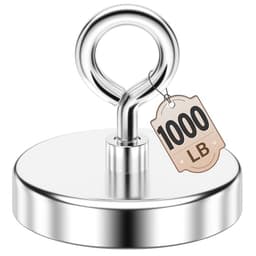
Why Your Magnet Is the Whole Game
Everything else in your kit — the rope, the gloves, the bucket — is support gear. The magnet is the thing doing the actual work. And I learned that the hard way. My first magnet was a cheap 300-lb pull thing I grabbed without thinking much about it. Dropped it off a bridge in a canal that I knew had junk in it, and I came up empty three times in a row. Switched to a proper neodymium magnet with real pull force, and the first drop I pulled up a handful of bolts, a wrench, and what turned out to be a vintage bike lock. Same water. Different magnet. That's the whole story.
The magnet determines what you can reach, what you can hold, and whether you're actually going to find anything interesting or just drag your rope around for two hours. A weak magnet won't grip heavy objects. A magnet with poor coating will corrode and lose strength fast. And a magnet that's too powerful for a beginner — yeah, those exist — can actually be genuinely dangerous if you don't know how to handle it. I'm not trying to scare anyone off, but a 1000-lb pull magnet that snaps to a submerged steel beam is not something you just yank free with your bare hands. Ask me how I know. Check out the magnet fishing accessories section if you want gloves, rope, and other stuff to go with whatever magnet you pick.
What to Actually Look For in a Magnet Fishing Magnet
Pull Force — And What Those Numbers Mean
Pull force is measured in pounds or kilograms and tells you the maximum holding force on a flat steel surface under ideal lab conditions. Real-world performance is usually lower — you're dealing with rusty surfaces, odd angles, and sediment. Under 500 lbs is fine for beginners who are learning technique and not trying to haul up anchors. The 500–1000 lb range is the sweet spot for most intermediate fishers. Over 1000 lbs gets into serious territory — great for deep water and big finds, but you need to know how to handle it safely.
Neodymium Grade: N42 vs N52
Neodymium magnets come in different grades — N42, N52, and everything in between. Think of it like tire compound ratings. N52 is stronger per unit size than N42. The higher the number, the stronger the magnetic field. Most good magnet fishing magnets are N52, which is currently the strongest grade available for consumer products. If a listing doesn't specify the grade, that's either an oversight or a red flag.
Single-Sided vs Double-Sided
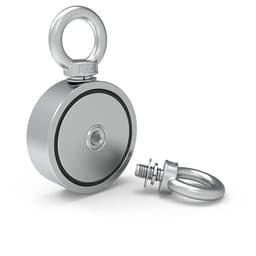
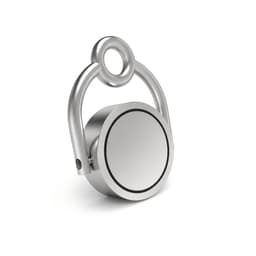
Single-sided magnets have one flat magnetized face. They're simpler and typically have stronger focused pull force on that one face. Double-sided magnets have a magnetized face on top and bottom — the idea being you can pick up stuff from multiple angles. Sounds great in theory. In practice, the pull force gets split between two faces, and I think double-sided magnets are a bit overrated for beginners. That said, they do have a real use case: dragging along the bottom horizontally where you want surface contact on both sides.
360-Degree Magnets
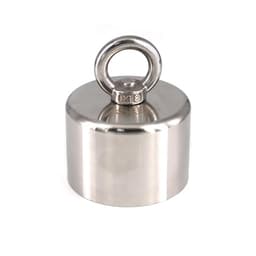
This is a different design entirely. Instead of a flat face pointing down, a 360-degree magnet has magnetic surface all the way around the cylinder. They're excellent for dragging through tight spots, along walls, or anywhere you want lateral attraction. They're also usually the most expensive type. If you're fishing in a canal with vertical stone walls or pulling alongside bridge pilings, the 360 design gives you coverage that a standard pot magnet just can't.
Coating: Nickel vs Epoxy
Bare neodymium is actually pretty fragile — it corrodes fast in water and chips easily. Nickel plating is the most common coating and gives decent corrosion resistance. Epoxy coating is thicker and more durable, better suited for saltwater or heavy use. Neither is perfect. Nickel can flake if you smash the magnet hard against rocks repeatedly (and you will smash it against rocks). Epoxy holds up better to impact but can crack at the edges over time. Most budget magnets use nickel. If you're fishing salty or brackish water, look for epoxy.
Eyebolt and Attachment Point
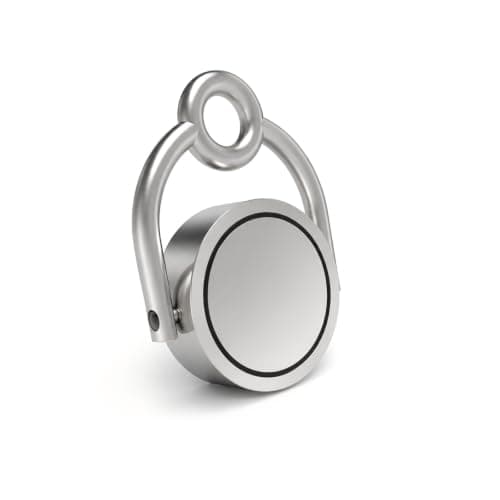
The eyebolt is how your rope connects to the magnet. Cheap eyebolts strip out or bend. Look for a threaded eyebolt with enough depth in the housing to hold under real tension. Some magnets come with the eyebolt already secured with thread-locking compound, which is what you want. If it comes loose in the field, your magnet goes to the bottom. That's an expensive drop.
The four magnets I’d actually buy, in order
The lineup above is ranked by what readers buy and how it rates. This list is mine. It runs from a $15 starter to a 3,100 lb allround magnet, and it’s ordered that way on purpose: most people should buy the first one, not the last one. Pull force is the headline number, but the right pick is the one that matches how often you actually get out on the water.
1.DIYMAG 500 LBS
Pull force: 500 lb · Best for: Your first magnet
This is the magnet I’d hand to anyone just starting out. Enough pull to find real things without being so strong that it’s dangerous to handle, from a brand that consistently sits near the top of the category.
- 500 lb at an entry-level price: the lowest-risk way to find out if the hobby is for you
- Light enough to throw all afternoon without wrecking your shoulder
- Strong enough for the usual first-outing haul: tools, tackle, bike parts, hardware
Bottom line: If this is your first magnet, buy this one. Spending more before you know how often you’ll go is the most common beginner mistake.
2.FINDMAG 1000 LBS
Pull force: 1,000 lb · Best for: The step up after a few trips
The right move once you’ve done a few sessions and know this hobby is your thing. Double the pull of the budget picks for a small jump in price, and this is where the finds start getting interesting.
- Holds heavier finds that a 500 lb magnet drops halfway up
- More forgiving of a bad angle, so fewer frustrating near-misses
- Still manageable for long sessions and easy to handle on the bank
Bottom line: The sweet spot for anyone past their first few trips who isn’t ready to spend three figures.
3.AOMAG 3300 LBS 360° N52
Pull force: 3,300 lb, 360°, N52 grade · Best for: Serious hunters in demanding spots
A 360-degree N52 magnet with 3,300 lb of pull. A real investment, but if you’re out every week in cluttered water and tired of heavy targets slipping away, this is the magnet that stops that happening.
- N52 is the strongest commercially available neodymium grade
- 360° pull grabs from any orientation, not just a flat face
- Built for repeated hard use rather than occasional outings
Bottom line: The best value in serious pull force if you fish often enough to justify it. At this strength, fingers can get pinched and steel moves toward it fast. Treat it with respect.
4.Magnetar Beast 3,100 lb Allround 360°
Pull force: 3,100 lb / 1,400 kg, 360° allround · Best for: Premium all-around performance
On Amazon the Beast ships as a kit: the same 3,100 lb magnet with rope, gloves and a case.
Magnetar built the Beast after the response to their Hardcore and Terror magnets, for people who want a genuine allround 360° magnet rather than a double-sided disc. It grips from any side, works through mud, and doesn’t hang up on rocks the way a flat magnet can.
- True 360° allround field: every surface is a working surface
- Magnetar build quality, now on Amazon
- Add the protective cover; hitting hard objects without one can damage the magnet
Bottom line: If you want Magnetar quality and 360° coverage, the Beast is the one.
Which one should you buy?
- Your first magnet: the DIYMAG 500. Affordable, manageable, and strong enough for real finds.
- Your second magnet: the FINDMAG 1000 doubles your pull for a small jump in price.
- Out most weeks: the AOMAG 3300 is the best value in heavy pull force.
- Premium allround: the Magnetar Beast gives you true 360° coverage and Magnetar build quality.
A note on pull force: the number on the box is a laboratory figure, a flat, clean, thick steel plate in direct contact. Real finds are rusted, awkwardly shaped and half-buried in silt, so treat the rating as a way to compare magnets against each other rather than a promise about what you’ll lift.
Our Top Picks at a Glance
| Image | Rank | Product | Price | Best For | Shop |
|---|---|---|---|---|---|
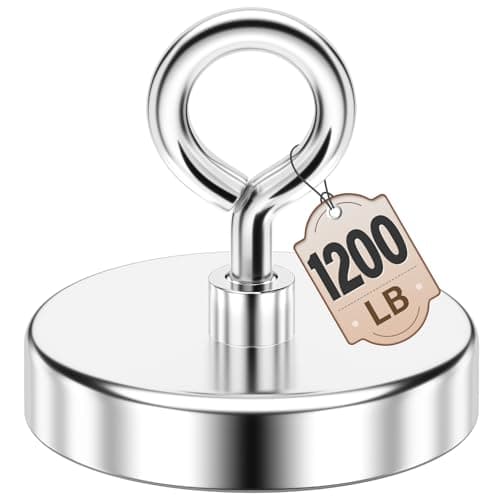
 | 1 | FINDMAG 1200 LBS Large Fishing Magnet | $35.99 | Best step-up from the top pick | Get the FINDMAG 1200 LB Magnet → |
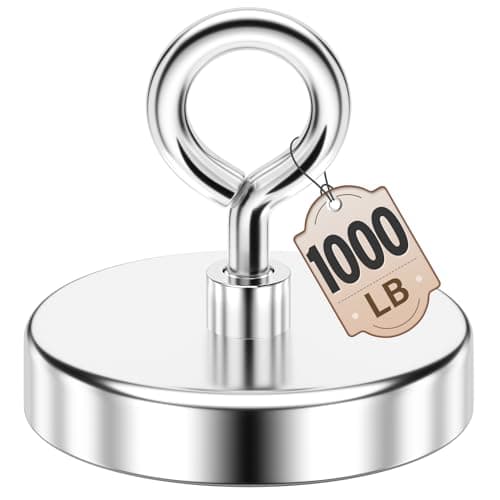
 | 2 | FINDMAG 1000 LBS High Power Fishing Magnet | $33.99 | Best overall magnet fishing magnet | Get the FindMag 1000LB → |
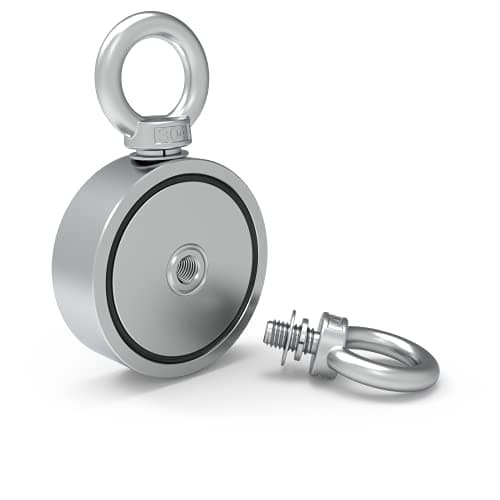
 | 3 | MHDMAG Double Sided 1000 LBS Fishing Magnet | $25.99 | Best budget double-sided magnet | Get the MHDMAG 1000LB Magnet → |
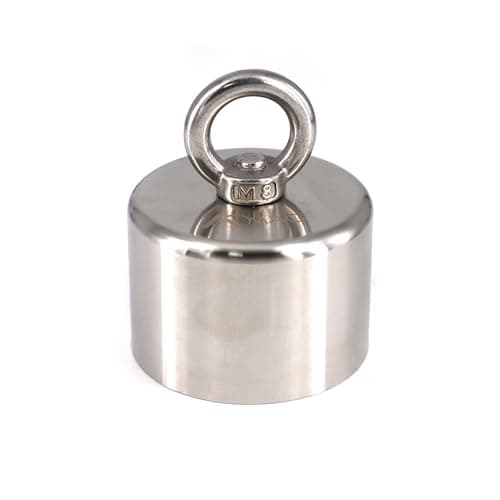
 | 4 | AOMAG 3300 LB 360° Fishing Magnet | $119.99 | Best 360-degree magnet for serious use | Get the AOMAG 3300LB Magnet → |
 | 5 | Ant Mag Neodymium Fishing Magnet with Eyebolt | $39.99 | Mid-range neodymium option with included eyebolt | Get the Ant Mag 1100LB Magnet → |
Which Magnet Should You Actually Get?
For most people, the FINDMAG 1000 LB is the answer. It's $33.99, it's got 1000 lbs of pull force, and it's a top seller for a reason. If you want to spend two more dollars for 200 extra pounds of force, grab the 1200 LB version instead — genuinely hard to argue against that trade. The double-sided MHDMAG is worth it if you're on a tight budget and want to try the dual-face design. And the AOMAG 360? That's for people who already know what they're doing and fish spots where the 360-degree coverage actually matters.
The magnet is the single most important piece of gear you'll buy. Don't overthink it too long — pick one, get out to the water, and start learning your spots. The best finds I've ever made came from places I almost didn't bother checking.
Frequently Asked Questions
What pull force magnet do I need for magnet fishing?+
It depends on where you're fishing and what you're trying to find. Under 500 lbs is fine for learning technique in shallow water. Most people doing this seriously use 500–1000 lbs, which handles the majority of finds. If you're targeting heavy objects in deep water, 1000 lbs and above gives you a real advantage.
What's the difference between N42 and N52 neodymium magnets?+
The grade number tells you the strength of the magnetic material — N52 is stronger than N42 per unit size. Most good magnet fishing magnets are N52, which is currently the strongest consumer-grade neodymium available. If a listing doesn't specify the grade, it's worth asking before you buy.
Are double-sided magnets better for magnet fishing?+
Not necessarily — and I'd actually say they're overrated for beginners. The total pull force on a double-sided magnet is split across two faces, which means less focused pull on any single surface compared to a single-sided magnet of similar rating. Where they do shine is horizontal dragging, where you want contact on both the top and bottom faces simultaneously.